But sympathy we cannot have. Wisest Fate says no. If her children, weighted as they already are with sorrow, were to take on them that burden too, adding in imagination other pains to their own, buildings would cease to rise (…) one great sigh alone would rise to Heaven, and the only attitudes for men and women would be those of horror and despair.
So said Virginia Woolf, on the individual and unknowable nature of illness, which in On Being Ill she argued to be deserving of the same literary attention bestowed upon love or war.
Enter, then, Hot Milk; the 2016 Booker Prize shortlisted novel by Deborah Levy. Telling the story of a mother and daughter’s journey to Spain to seek answers to the undiagnosed condition that affects the mother’s ability to walk, itweaves a messy tapestry of illness, family, memory, trauma and love.
Hot Milk pays close attention to the ripple effect of ill health, and how it permeates all aspects of life for the sufferer and those around them. This ripple effect is of particular interest in light of Woolf’s assertion of the individuality of illness.
The illness in Hot Milk belongs to the mother, Rose; but its repercussions are borne by her daughter, Sofia, through whom the story is told. It is from Sofia that we come to understand the frustration, isolation and vulnerability that are the side effects of her mother’s pain. These shape both of their lives but perhaps affect Sofia even more deeply, for the complete lack of control that her degree of separation from the illness itself brings. She is not the patient, yet it is her life that is put on hold.
Levy hints to Rose’s condition being somewhat psychosomatic; inextricably wound up in personal history and unresolved emotional suffering. The story of her symptoms is ever-changing, to the point where the illness is posited as virtually unknowable, to its sufferer and those around her.
“We do not know our own souls, let alone the souls of others”, attested Woolf, and Hot Milk makes this achingly obvious. We witness the difficulty Sofia has in detaching her own identity and sense of self from her mother’s, which begins and ends with her pain. Through this struggle, and in the midst of untangling the alluded psychological element of Roses’s suffering, Levy sets out an interesting discussion into generational and inherited trauma, psychosomatic disorders and the fragile coexistence of body and mind.
This is, of course, all contrary to Woolf’s assertion that illness cannot be a burden shared. As such, sympathy is futile: each person’s experience of illness is unique and cannot be replicated or related to. In Hot Milk, sympathy is weaponised, as Rose seeks it from Sofia and those around her and holds it as leverage, whilst the narrative of her symptoms remains erratic.
As if in response to Woolf’s belief that the English language is not adequately equipped to portray illness, Levy draws upon a kind of magical realism to tell the story. The novel’s imagery is innately filmic: tiny moments of wonder are prized out of the mundanity, and are played out into beautiful, cinematic details.
It therefore seems only natural that Hot Milk should be adapted into a screenplay. Directed by Rebecca Lenkiewicz and starring Emma Mackey and Fiona Shaw, the film premiered at the Berlin Film Festival in February, and is due to be released by Mubi on 4th July.
In spite of its cinematic potential, and perhaps as a result of the pensive, almost philosophical style of Levy’s writing, prior adaptations of the author’s prose have struggled to translate to screen without veering into pretension. Indeed, whilst certain criticisms of Lenkiewicz’s film have levied similar judgements, I’d argue that these miss the point.
The beauty of Hot Milk lies in its ambiguity. Levy conveys the human experience of illness through a patchwork of memory, metaphor and mysticism, which sensitively avoids leaning on more heavy-handed, prescriptive imagery, thus affirming Woolf’s assertion of individuality in illness. Lenkiewicz’s adaptation manages to work with this choice of the original text rather than struggling against it, all without becoming overly self-conscious. The film feels faithful to the sense of the original work, even when it (unavoidably) strays at times from literal translation.
Levy’s minute details, like the stinging medusas on the beach, are employed as recurring motifs in such a way that transforms them into something borderline mythical. This, paired with the power of the rich contrasts of the mise en scène — the shadowy interiors vs the blazing Spanish sun; Sofia’s sexual awakening vs the sterility of the medical clinic — creates a deeply appealing visual language.
It is this language that is able to expand on the dilemmas of love and duty in sickness that the book poses. Through Mackey’s stormy portrayal of Sofia in particular, we see most painfully that all the love in the world cannot make someone better; and that whilst love cannot be exhausted, patience certainly can be.
Virginia Woolf lamented the inadequacy of the English language in accurately depicting illness, but Hot Milk makes a strong case for cinema, with its audio-visual vernacular, being better equipped to give form to it. I wonder if she’d be impressed.
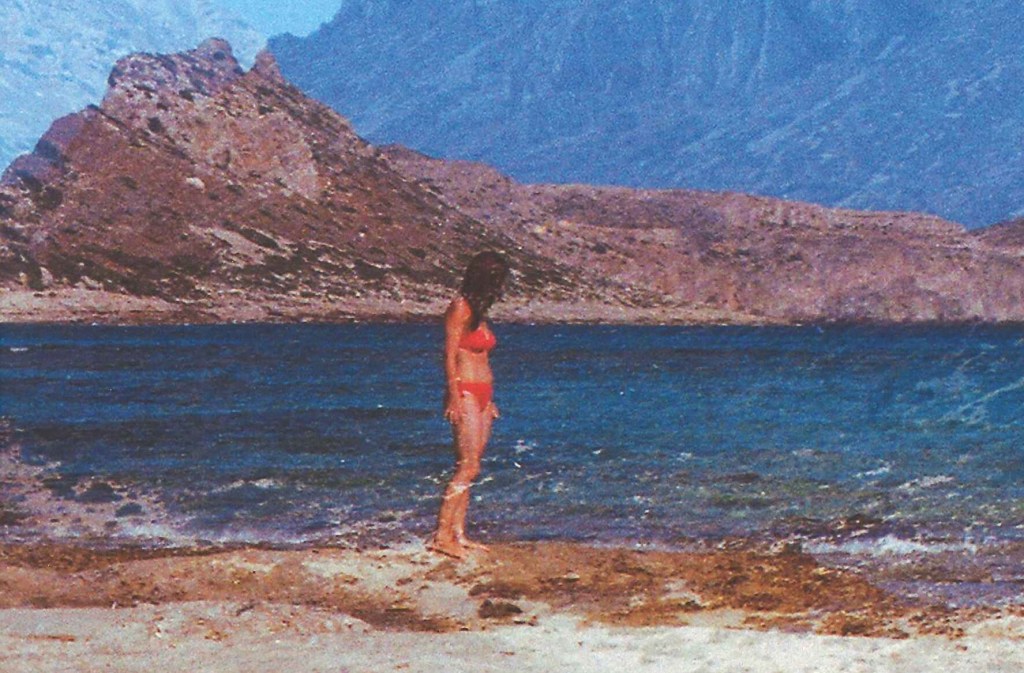
Image credit: “Hot Milk” by Deborah Levy, cover (close-up)
 Mia Siitonen
Leave a comment